Reference reading
Domination
Collaboration can become a performance in which one person keeps every handle.
A persistent desire to control others that overrides their reasonable agency.
Imagine this: During a puppet rehearsal, the director has gathered all the control strings into one hand. The puppets now move together very reliably—and cannot perform the scene.
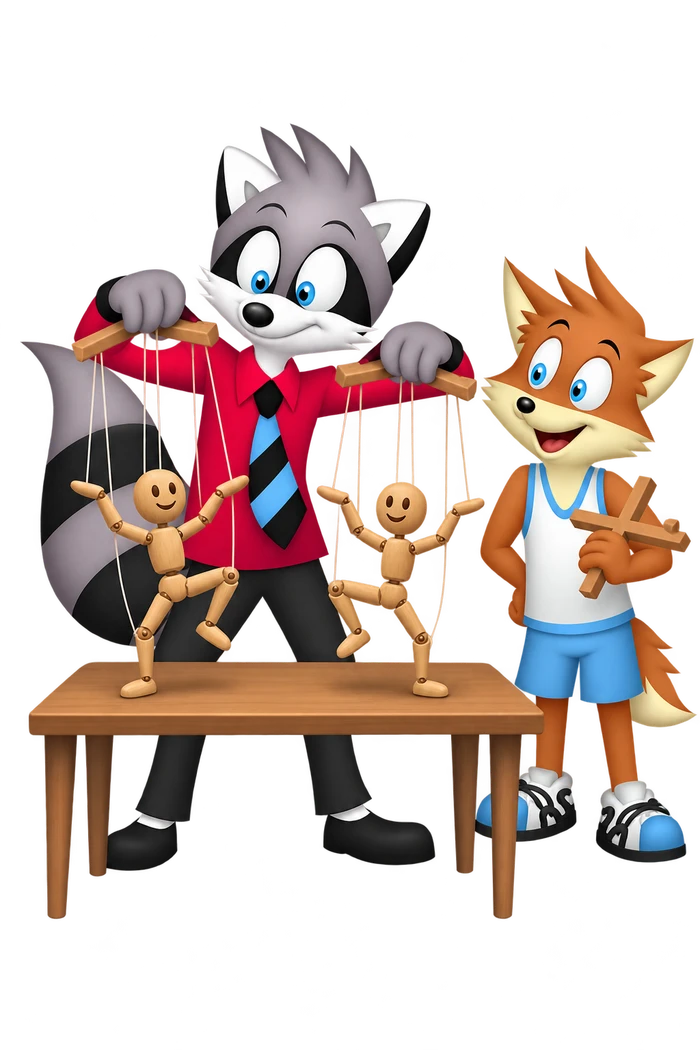
How the pattern works
Domination is the familiar display name here for Domineeringness: a persistent desire for control that overrides reasonable agency. In creative work it can appear as an inability to let collaborators make decisions that genuinely belong to them. Delegation becomes a loan of the director’s hands, revocable whenever another person exercises judgment.
Direction is a real contribution. A performance, publication or exhibition needs decisions, constraints and someone willing to hold a purpose together. The distinction is whether authority serves the shared undertaking within defensible limits or becomes an appetite to determine others’ choices regardless of their reasonable agency.
What it costs the work
Initiative becomes risky, and responsibility becomes confused. Contributors are asked to own outcomes while denied the choices that shape them. The controlling person may become a bottleneck, yet interpret the resulting dependence as proof that nobody else can be trusted to act.
A distinction worth keeping
Possessiveness claims ownership of another person’s attention or attachments; Domination concerns control more generally. A director may micromanage a collaborator without seeking exclusive loyalty. Conversely, a mentor may leave the work free but resent independent friendships. Justified editing, supervision and coordination are not inherently domineering.
What a useful response can change
Make the boundaries of a role intelligible: what is fixed by the project, what can be decided independently, and how disagreement will be resolved. A person needs real room to exercise a responsibility.
A concern about a decision can be stated as a reason open to discussion rather than a demand that every movement pass through one hand.
Where control has displaced collaboration, a useful repair returns particular choices and acknowledges what the earlier arrangement made impossible. An invitation to “take initiative” has little meaning if independent action is still punished.
Questions for reflection
- Which decision am I retaining because the work requires it, and which because another person might choose differently?
- Who carries responsibility without the corresponding agency?
Other perspectives
But reflecting persons perceived that when society is itself the tyrant—society collectively, over the separate individuals who compose it—its means of tyrannising are not restricted to the acts which it may do by the hands of its political functionaries.
John Stuart Mill · On Liberty · Read the source
Mill extends concern about tyranny beyond official political acts. Cultural relationships can override agency without the controller holding public office.
The thought of genius is spontaneous; but the power of picture or expression, in the most enriched and flowing nature, implies a mixture of will, a certain control over the spontaneous states, without which no production is possible.
Ralph Waldo Emerson · Essays, First Series · Read the source
Emerson describes the will involved in making artistic expression possible. Control over one’s own creative process does not by itself justify control over another contributor’s choices.