Too little
Attractive impulse
“It looks good; we can discover the effects later.”
Novelty gets ahead of knowledge and consent.
Think beyond the attractive first result.
A disposition to weigh consequences before choosing a worthy course of action.
In a garden, prudence asks what may follow an introduction, removal or rearrangement, including consequences beyond the border you can see. The aim is proportionate forethought, not a prediction of everything that could possibly happen.
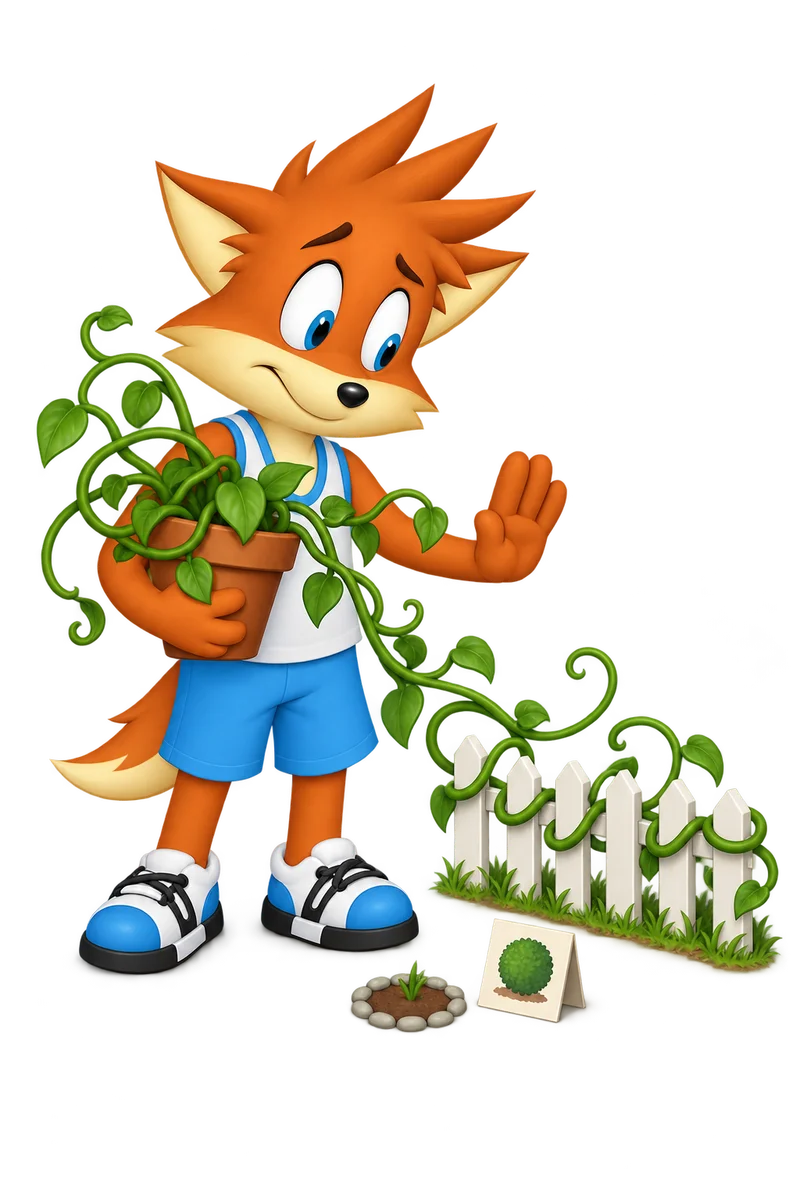
The plant in the picture fits perfectly inside a neat little border. The plant itself has ambitions beyond the picture. Your neighbor’s bed lies just across the fence. Prudence asks about growth habits before a handsome arrival becomes a shared surprise.
An illustrative everyday situation
You want to plant a vigorous spreader beside a shared boundary.
Too little
“It looks good; we can discover the effects later.”
Novelty gets ahead of knowledge and consent.
A fitting response
“What is it, what guidance applies, and who else is affected?”
Relevant uncertainty is examined before commitment.
Pursued too far
“Unless every outcome is certain, nothing can change.”
An impossible standard prevents reasonable ordinary decisions.
Forethought is accountable to likely consequences, not every imaginable story.
For a harmless layout choice, an agreed reversible trial may answer a question. For unfamiliar living material or a consequential change, a trial is not a substitute for reliable guidance.
A timely question can keep a pleasing idea from becoming someone else’s recurring problem. Prudence cannot eliminate uncertainty. It helps distinguish uncertainty you can reasonably live with from knowledge you need before proceeding.
You learn how a plant spreads and discuss the intended place with the person tending the next bed.
You check that a new arrangement will leave room to reach the watering tap and carry supplies.
Humility admits the knowledge gap; prudence considers what acting within that gap could do.
Curiosity seeks understanding; prudence weighs whether enough relevant understanding is present for action.
An elaborate check that misses the people affected can imitate prudence. Relevant consequences matter more than the size of the checklist.
Saying “we will sort it out” after an avoidable commitment is a counterfeit of forethought. Ask while the choice is still open.
Name who may bear the consequences.
Check the identity and scope of what you are considering.
Prefer a proportionate reversible option where that is genuinely suitable.
Before adding a plant, find out about its growth habit and suitability for your location. If it could affect a shared bed or boundary, discuss the proposed place with the other gardener.
Learn a plant’s habits before giving it a place.
Which consequence lies beyond the border in my drawing?
Who will do the work if this plant needs more room than I expected?
Check local suitability before introducing a plant. A reassuring label or attractive photograph is not enough to establish its likely effects.
About these practices · DisclaimerSeven selections to return to through the week. Follow a source link to read the surrounding passage.
There is surely no greater wisdom, than well to time the beginnings, and onsets, of things.
Francis Bacon · Essays · Of Delays · excerpt
Bacon makes timing part of judgment. The satisfying moment for a change may arrive before you understand its consequences.
If a man take no thought about what is distant, he will find sorrow near at hand.
Confucius · Analects · XV.11; Confucius speaking · James Legge translation · excerpt
Confucius asks for thought beyond the immediate moment. A shared garden decision includes future care and the people who will provide it.
(The master of it) anticipates things that are difficult while they are easy, and does things that would become great while they are small.
Laozi · Tao Te Ching · 63.2 · James Legge translation · excerpt
Laozi favors attention while a difficulty is still manageable. A question before an unfamiliar introduction can prevent work that is harder to undo.
So convenient a thing it is to be a reasonable creature, since it enables one to find or make a reason for everything one has a mind to do.
Benjamin Franklin · Autobiography · Part I, the fish dinner · excerpt
Franklin notices reason serving a preferred desire. An attractive plant or plan does not supply its own justification.
In every affair consider what precedes and follows, and then undertake it.
Epictetus · Enchiridion · 29 · Elizabeth Carter translation · excerpt
Epictetus asks what precedes and follows an undertaking. Consider continuing care, access and other users of the space before committing to the picture.
And some people make the mistake of trying to begin at the end, and of using recklessly what may want the utmost caution,
Jekyll immediately names strong chemical manures as her example. The excerpt supports seeking competent local guidance; no historical treatment, product or dose is recommended.
there is so infinitely much to learn, and the conditions of different gardens vary so greatly,
Gertrude Jekyll · Wood and Garden · Chapter I, Introductory; variation between gardens · excerpt
Jekyll questions easy transfer between superficially similar gardens. A method that worked elsewhere still needs a reason to fit this place.
Read freely, follow the fourteen-virtue program, or adapt this collection in My Virtues. A harvest is never a character score.