Too little
Repeat the answer
I can recite the solution, so I must understand it.
Repeating the conclusion leaves the unexplained step untouched.
Give a difficult idea time to become your own.
A willingness to allow worthwhile processes their necessary time.
Patience lets understanding take the time it needs. You can stay interested while an explanation remains difficult, return to an earlier step, and let a question remain open. This gives learning room to become more than the memory of an answer.
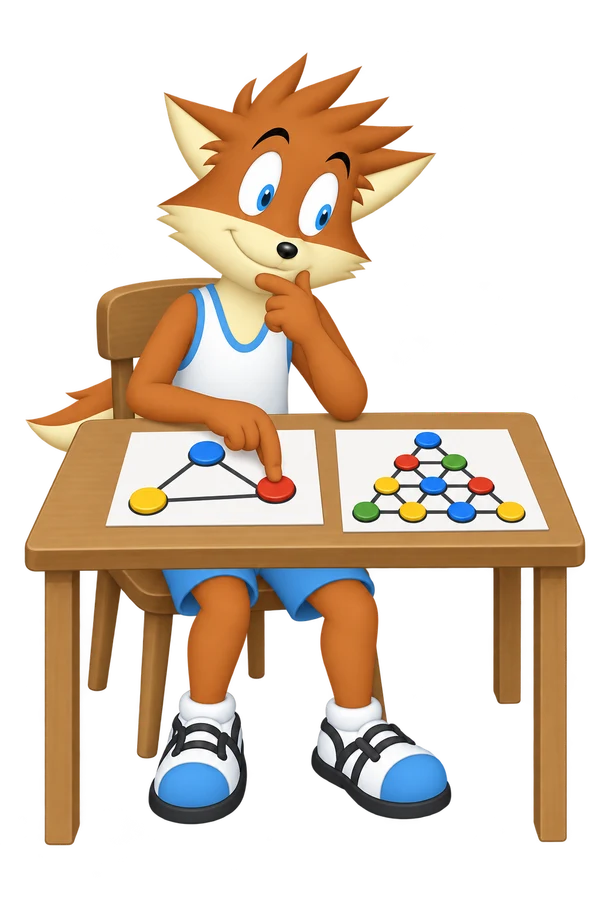
A puzzle solution says the next step is obvious. You have looked at it for ten minutes, and the word is becoming less helpful by the minute. You draw a smaller version and move three counters through it. The answer has not changed, but at last you can see why it follows.
Allow understanding to develop through a simpler example rather than memorizing a mysterious answer.
Too little
I can recite the solution, so I must understand it.
Repeating the conclusion leaves the unexplained step untouched.
A fitting response
I will try the same step with three counters.
A smaller example gives the question a manageable form and time to develop.
Pursued too far
I will stare at this page until the explanation becomes clear.
Allowing time becomes unexamined waiting when another example or a question would help.
Time helps understanding when you give it something to work with: a smaller case, a fresh explanation, or a question to revisit.
A slower encounter with an idea can reveal where your reasoning changes direction. Instead of remembering that a puzzle has a clever answer, you begin to recognize why that answer works and when the method might help elsewhere. The moment a connection becomes clear can be a pleasure of its own, even when the printed answer has been sitting beside you all along.
Read several ordinary examples before demanding a rule that explains every form.
Pause at the first unclear step and formulate a question about that step.
Diligence supplies careful effort; Patience allows the process its necessary duration.
Perseverance brings you back after setbacks; Patience changes how you inhabit the time spent learning.
Rereading the same opaque sentence without trying another approach can mimic Patience. A patient learner can seek a clearer example.
Calling a rule mysterious and learning it by rote abandons a question you still want to understand.
Make the difficult example smaller.
Separate not understanding yet from evidence that an explanation is poor.
Return after a break when another pass has become mechanical.
Take one explanation that loses you. Identify the first step you cannot follow and try a smaller example. Leave a question to return to if it remains unclear.
You can stop or choose another resource. Pain, exhaustion and frustration are not measures of how seriously you are learning.
Seven selections to return to through the week. Follow a source link to read the surrounding passage.
When you come to any passage you don’t understand, read it again: if you still don’t understand it, read it again: if you fail, even after three readings, very likely your brain is getting a little tired. In that case, put the book away, and take to other occupations, and next day, when you come to it fresh, you will very likely find that it is quite easy.
Lewis Carroll · Symbolic Logic · To Learners, rule 3
Carroll makes returning with a rested mind part of learning a difficult passage. The smaller puzzle likewise gives understanding room to develop; another attempt need not happen immediately.
Time is required in order to digest impressions, and translate them into substantial ideas.
John Dewey · How We Think · Natural Resources in the Training of Thought
Digesting an impression into an idea takes more than exposure to a fact. A smaller example gives that conversion time and a concrete object.
A silent, uninterrupted working-over of considerations by comparing and weighing alternative suggestions, is indispensable for the development of coherent and compact conclusions.
John Dewey · How We Think · The Recitation and the Training of Thought
The pause is occupied by comparing alternatives. Patience in the puzzle scene is active reflection, rather than staring at an unexplained solution until the clock moves.
If I should ever learn anything about this delicate point, I shall owe it to some happy chance for which I must wait, or rather watch, patiently.
Fabre corrects waiting to watching. The distinction gives patience an observant task while acknowledging that the hoped-for answer may not arrive on demand.
When I have made these comprehensive arrangements, there is nothing more to be done; and I wait patiently for the building-season to open.
The observation depends on a season the investigator cannot accelerate. Preparation has a proper endpoint after which allowing the process time is itself the fitting action.
These causes combined have given me the patience to reflect or ponder for any number of years over any unexplained problem.
Charles Darwin · The Autobiography of Charles Darwin · Written May 1, 1881
Darwin relates prolonged reflection to a desire to understand. The duration belongs to his particular scientific life, rather than setting a mandatory pace for a reader.
I am therefore a poor critic: a paper or book, when first read, generally excites my admiration, and it is only after considerable reflection that I perceive the weak points.
Charles Darwin · The Autobiography of Charles Darwin · Written May 1, 1881
A first impression can be admiration, with discrimination arriving later. The passage makes a second, slower encounter useful without making speed the measure of understanding.
Choose this approved collection as an optional workbook program, or select individual virtues in My Virtues.