Too little
Making everything useful
“Let’s turn this into a proper lesson about money.”
An invitation to imagine becomes another exercise with an adult in charge.
Make room for a little shared nonsense.
Readiness to make room for humane, shared lightness without making dignity its price.
Playfulness welcomes humane, shared lightness without making dignity its price. In family life, it may mean entering an invented world without immediately improving it. The invitation remains open to refusal; play is shared enjoyment, not an adult’s compulsory cheerfulness exercise.
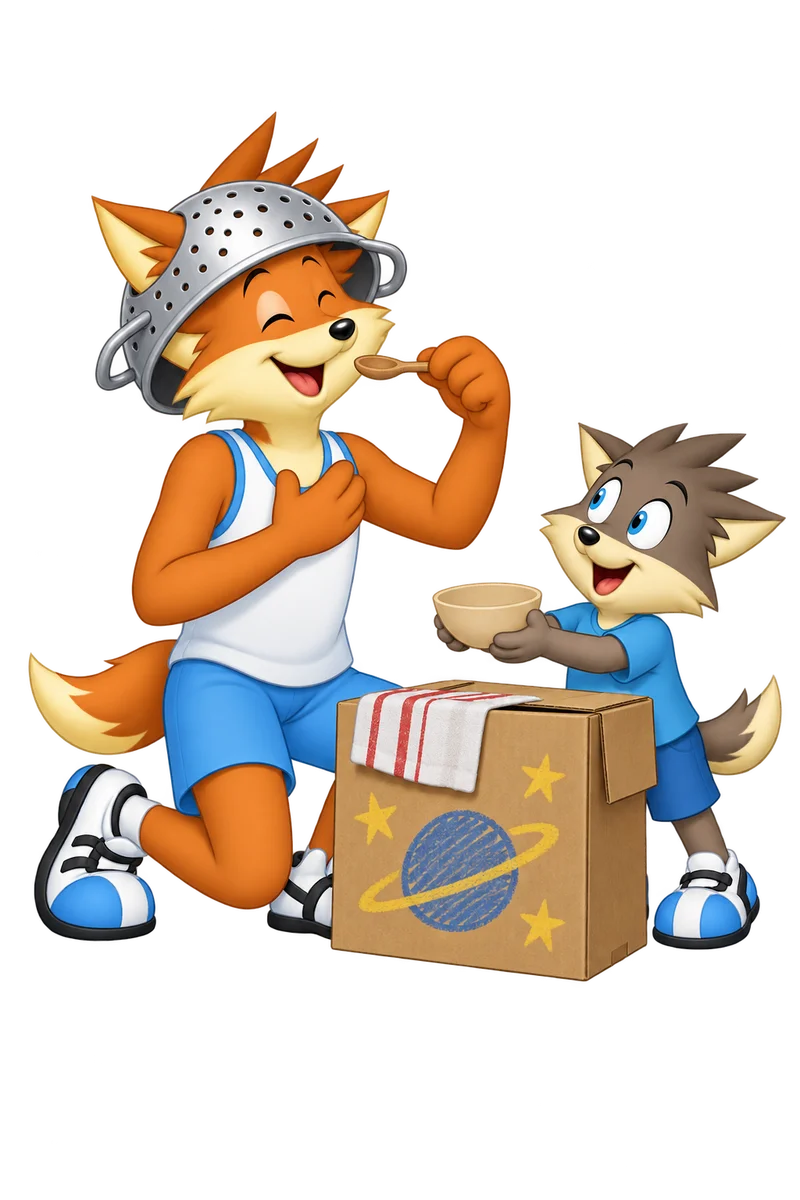
The sofa has become a boat. You could explain why its construction is unsuitable for navigation. Or, if the moment allows, you could ask where it is going. Not every family activity needs a learning objective and a clipboard.
An illustrative everyday situation
A child invites you to be a customer at a shop that sells invisible soup. You are told that the spoon is imaginary too.
Too little
“Let’s turn this into a proper lesson about money.”
An invitation to imagine becomes another exercise with an adult in charge.
A fitting response
“May I have the soup that makes a very quiet splash?”
You contribute to the game while leaving room for the child’s invention.
Pursued too far
“You have to laugh; this is supposed to be fun.”
Play becomes pressure when someone’s interest or energy has ended.
Shared lightness needs room for both people’s contributions and for either person to stop. The game is not improved by winning control of it.
With a teenager or adult child, play might be wordplay, a favorite board game, or a ridiculous shared observation. Do not assume they want a childhood game revived in public.
An ordinary afternoon can hold a moment of company that is neither correction nor assessment. The pleasure may be brief, quiet, or wonderfully silly; it need not become a family tradition.
You let a blanket tent become the place its builder says it is, and ask what a visitor needs to know.
An older child offers a harmless running joke. You enjoy it together without telling it to an audience they did not choose.
Generosity makes time available; playfulness lets some of that time be light and unproductive.
Tact considers the audience and another person’s dignity. It helps keep a shared joke from becoming a joke at someone’s expense.
Insisting everyone join in can ignore tiredness or sadness. Make an invitation, not a mood requirement.
A laugh does not make ridicule kind. Choose humor the other person can freely enjoy.
Notice an invitation before turning it into instruction.
Contribute one small idea without taking over the game.
Recognize a change of mood or a wish to stop.
Playfulness does not require energy, extroversion, unwanted touch, risky play, or joking through distress. Keep supervision and other responsibilities appropriate. Do not make a child responsible for cheering up an adult.
If a welcome, harmless game or joke presents itself, join it on mutually agreeable terms. A short moment is enough; there is no required duration or performance.
Join their harmless game without taking over the rules.
Did I join the game or quietly become its supervisor?
Can the other person stop without disappointing me into pressure?
Playfulness does not require energy, extroversion, unwanted touch, risky play, or joking through distress. Keep supervision and other responsibilities appropriate. Do not make a child responsible for cheering up an adult.
About these practices · DisclaimerSeven selections to return to through the week. Follow a source link to read the surrounding passage.
Kindergarten play takes the children where they love to be, into the world of "make-believe."
Kate Douglas Wiggin · Children’s Rights: A Book of Nursery Logic · Children’s Plays · excerpt
Wiggin describes the invented worlds of kindergarten play. A parent can enter a harmless imagined setting without replacing it with a lesson.
a stout gentleman was frolicking with two little boys on the sofa,
Louisa May Alcott · Little Men · chapter I, Nat; narrator · excerpt
Alcott introduces Father Bhaer playing with the children. The scene gives the adult a place inside shared enjoyment; rough play or touch is never required.
I fluttered my clumsy apologies for wings, and forgetting self, flew about with all the others, as happy as a bird.
Wiggin remembers joining an imaginative game despite self-consciousness. This is her voluntary experience, not a reason to make a reluctant person perform.
If you are skeptical, let me beseech you to join the children in a Free Kindergarten, and play with them.
Kate Douglas Wiggin · Children’s Rights: A Book of Nursery Logic · Children’s Plays · excerpt
Wiggin invites adults to experience children’s play. Her adjacent claim that nobody can resist it is not adopted: participation, mood, and energy remain personal.
sunshine, children’s laughter, hum of bees, and scent of flowers are being bottled up for after refreshment.
Charlotte M. Mason · Home Education · Part II, Out-of-Door Life for the Children; p. 43 · excerpt
Mason evokes the sensory pleasure of a shared outdoor day. The image invites enjoyment; her adjacent physiological claims and prescribed schedules are not adopted.
And in the sweetness of friendship let there be laughter, and sharing of pleasures.
Kahlil Gibran · The Prophet · On Friendship; Almustafa speaking · excerpt
Almustafa makes room for laughter and shared pleasures in friendship. The analogy illuminates companionship in family play without dissolving the adult’s responsibilities.
the perpetual cackle of his elders leaves the poor child not a moment of time, nor an inch of space, wherein to wonder—and grow.
Charlotte M. Mason · Home Education · Part II, Out-of-Door Life for the Children; p. 44 · excerpt
Mason objects to adult chatter occupying every moment. Playfulness can leave space for invention without an explanation of what each game is meant to teach.
Read freely, follow the nineteen-virtue program, or adapt this collection in My Virtues. These are practices for your own choices, never a scorecard for a child.