Too little
Efficient blindness
The objective succeeds, so the method is justified.
People outside the plan disappear from its cost calculation.
Consider who could bear the consequences of a proposed action before admiring how efficiently it solves the immediate problem.
A disposition to weigh consequences before choosing a worthy course of action.
Prudence weighs consequences before choosing a worthy course. It asks not only whether an action works quickly, but who may bear its privacy, safety, livelihood, or relational costs. Prudence does not require perfect prediction; it requires noticing foreseeable effects and choosing a proportionate route.
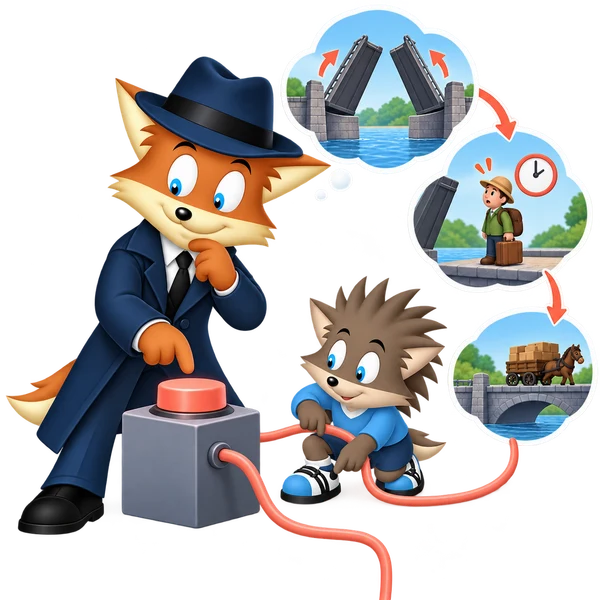
A plan would achieve its objective quickly, but the convenient route exposes a translator’s livelihood and a family’s privacy. You redraw the plan after counting costs that were absent from the briefing table. The slower route is not timid; it is the first one that includes everyone who would pay.
A successful plan must change when its privacy and livelihood costs fall on people outside the room. The button is still very pleased with itself.
Too little
The objective succeeds, so the method is justified.
People outside the plan disappear from its cost calculation.
A fitting response
Choose the route that meets the legitimate aim while reducing foreseeable harm.
Means, reversibility, and affected people belong inside the decision.
Pursued too far
No action is safe enough to begin.
Risk awareness becomes a way to avoid proportionate responsibility.
A brief check for bystander costs can prevent the repair, distrust, and delay created by an impressive shortcut.
A decision can remain effective while reducing collateral exposure and preserving options for correction.
Choose a recipient who can act instead of copying people who cannot help.
Check whose private circumstances a convenience change would reveal.
Discretion governs disclosure; Prudence surveys the wider consequences of the chosen route.
Courage faces proportionate cost for a worthy purpose; Prudence helps choose which risk is justified.
Considering only the decision-maker’s reputation ignores the people affected.
Admiring the shortest route can hide costs displaced onto someone else.
List who could be helped, burdened, exposed, or excluded by the action.
Prefer a reversible first step when the evidence remains incomplete.
Set a point for review so foresight does not become indefinite delay.
For one low-stakes plan, list who receives the benefit, who bears the inconvenience, and which cost can still be reduced.
Seven selections to return to through the week. Follow a source link to read the surrounding passage.
I shrank from the responsibility and counted the cost of failure—certain failure, to judge by her conduct.
Carruthers does not confuse urgency with capacity. Counting the likely cost of failure is a sober check on a plan that involves other people.
These are daring men, and though we shall take them at a disadvantage, they may do us some harm unless we are careful.
The warning anticipates harm even while action remains necessary. Prudence appears as preparation for foreseeable danger, not an excuse to abandon the task.
Let us consider for a moment what most of the trouble and anxiety which I have referred to is about, and how much it is necessary that we be troubled, or, at least, careful.
Thoreau asks how much anxiety is necessary before accepting it as the price of living. The question redirects attention from habit to proportion.
There was a big risk that, even if I weathered the other dangers, I would not be believed in the end.
Hannay recognizes that surviving the immediate danger will not make his account credible. The second-order consequence changes what a successful plan requires.
And he would go up to Umballa leisurely and—at a certain risk of exciting fresh suspicion—repeat his tale by word of mouth to the people concerned.
Rudyard Kipling · Kim · captured passage near source unit 145
Kim’s messenger weighs the cost of using the faster channel against the risk of attracting attention. The tradeoff is concrete and belongs to the people affected.
I ran the risk of giving myself away to find somebody for that accursed job.
Joseph Conrad · The Secret Agent: A Simple Tale · captured passage near source unit 987
Verloc’s complaint measures risk only against his own position and resentment. That narrowed calculation is a useful counterfeit of prudence.
But I had much rather think of you in danger there than see you exposed to what may be met here.”
The speaker compares two kinds of exposure instead of calling either option safe. Prudence begins with that refusal to erase the worse cost.
Choose this approved collection as an optional workbook program, or select individual virtues in My Virtues.