Too little
Familiarity mistaken for knowledge
It has always done that.
Repeated observation stands in for understanding.
The bird nods every time. You would like to know why.
A settled desire to understand rather than remain content with unexamined assumptions.
Curiosity wants to understand what familiarity can make invisible. A little hand-cranked toy has always made its bird nod, but the motion is not an explanation. Following the exposed gears can turn “that is what it does” into a more useful question. Self-reliance grows through learning how to inquire, including when to ask someone who understands more.
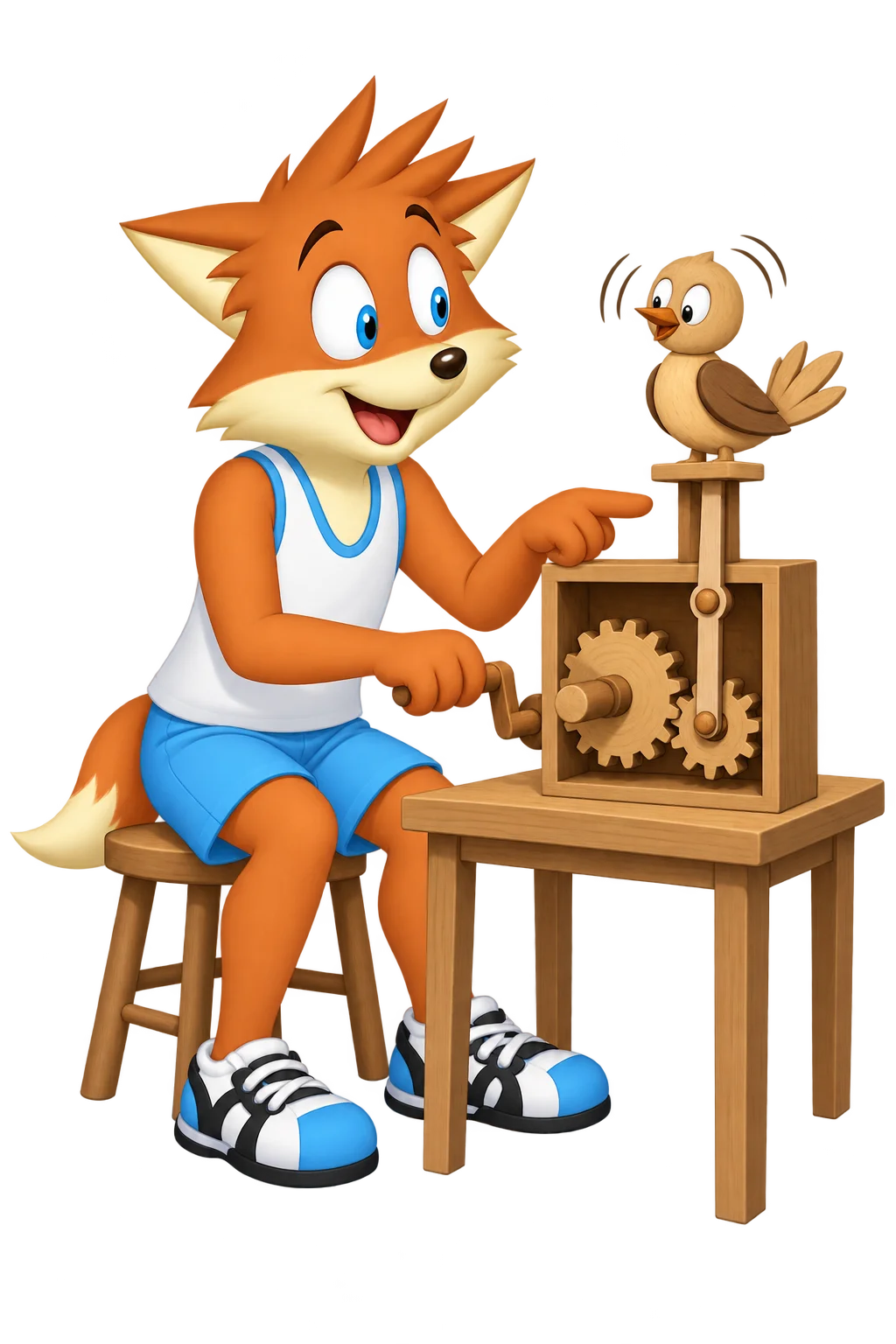
You turn the handle of a wooden toy and watch its bird nod with excellent, entirely unearned agreement. This time you look below the bird. A wheel turns, a small arm moves and the head dips. You slow the handle to follow the connection. The toy has not become less delightful because you are interested in how it works. It has acquired another way to be interesting.
An illustrative everyday situation
Watch the exposed wooden linkage of a hand-cranked toy rather than only its nodding bird.
Too little
It has always done that.
Repeated observation stands in for understanding.
A fitting response
Which movement makes the head dip?
A small question guides attention toward an explanation.
Pursued too far
I must dismantle it to satisfy myself.
Interest overrides permission, care or the limits of the task.
Recognizing an effect does not mean you understand its cause.
If a mechanism is enclosed, fragile or hazardous, observation may stop at a question for someone qualified. The scene uses an accessible hand-operated toy; it is not encouragement to open appliances or someone else’s belongings.
Curiosity can reveal a missing assumption and make help more useful. Instead of asking someone to take over everything, you may be able to ask about one connection. An explanation can also show where your present understanding ends.
Learn how a familiar tool or simple household process works, then use the explanation in a suitable task of your own. Understanding becomes more exact when it has to guide a choice.
For an ordinary permitted task, ask why a particular step comes before another.
Curiosity seeks an explanation; Discernment examines whether it is well supported and relevant.
Prudence sets limits on how an inquiry is pursued, especially when equipment or expertise is involved.
Information gathered only to display knowledge can mimic Curiosity while leaving the actual question untouched.
Being fascinated does not make private objects or information yours to examine. Genuine inquiry respects their boundaries.
Notice a familiar effect you cannot yet explain.
Ask a specific question about the connection.
Check an appropriate explanation and acknowledge what remains unclear.
Choose an ordinary object you own or a public example you may inspect. Observe one detail, seek an explanation and test your understanding through a suitable use. Leave hazardous equipment and private belongings alone.
Ask how familiar things work, and pursue understanding.
What do I recognize without understanding?
Which part of the explanation could I describe in my own words?
Curiosity does not confer permission or technical competence. Use observation and appropriate sources; do not dismantle hazardous equipment or intrude on privacy.
About these practices · DisclaimerSeven selections to return to through the week. Follow a source link to read the surrounding passage.
For use is one thing, and understanding is another;
Epictetus distinguishes using appearances from examining them. The nodding toy makes a small version of that distinction visible.
And now it was that, being on some occasion made asham'd of my ignorance in figures, which I had twice failed in learning when at school, I took Cocker's book of Arithmetick, and went through the whole by myself with great ease.
Franklin describes returning to arithmetic after earlier difficulty. The useful invitation is renewed inquiry; shame and his reported ease are not requirements or guarantees for another learner.
the continually being accustomed to anything, blinds the eye of our judgment.
Montaigne observes how custom can conceal what is strange. A familiar toy can become an object of inquiry when its ordinary motion is allowed to puzzle you.
He cultivated carefully that habit of active attention on which all the higher working qualities of the mind mainly depend.
Samuel Smiles · Self-Help · Chapter II, Leaders of Industry · 1897 edition · excerpt
Smiles describes the inventor James Watt’s attention in a historical narrative. The selected point is sustained observation; his sweeping claim about mental qualities is not treated as scientific evidence.
I’ll help you with the hard words, and they’ll explain things if we don’t understand,
Beth offers Amy help with the Christmas books and expects help from their older sisters too. Understanding can be pursued together; the surrounding devotional reading does not make a religious practice obligatory here.
If the cultivation of the understanding consists in one thing more than in another, it is surely in learning the grounds of one's own opinions.
Mill asks for knowledge of the reasons behind a belief. Knowing that a toy moves, or that a method works, can be the beginning of a question rather than the end.
History, Poetry, Mythology!—I know of no reading of another’s experience so startling and informing as this would be.
Thoreau has just imagined looking through another person’s eyes. His wish broadens inquiry beyond private experience: another perspective may reveal what familiarity hides.
Read freely, follow the fourteen-virtue program, or adapt this collection in My Virtues. A small choice can give you something useful to practice.