Too little
The complete expert view
“The drawing is clear; people will understand it.”
The planner treats an untested representation as complete knowledge.
Correct a policy assumption when affected people reveal what you overlooked.
Openness to recognizing the limits of one’s knowledge and importance.
Humility recognizes the limits of one’s knowledge and importance. A public plan can be carefully prepared and still omit something plain to its users. Humility allows their experience to correct the picture without making either professional knowledge or lived experience automatically infallible.
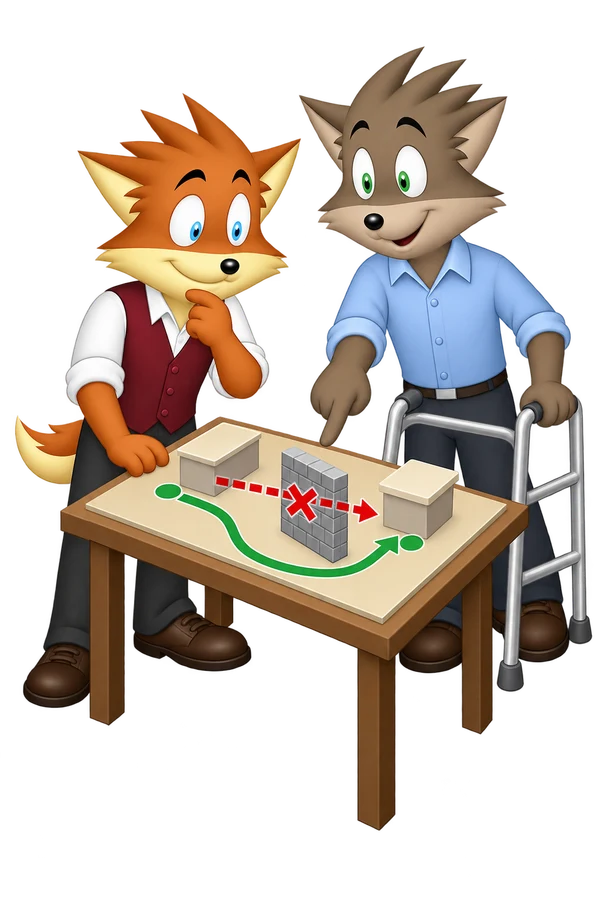
The service map shows a short, elegant route between two counters. A resident traces the actual journey: outside, around the building and back through the only step-free entrance. Your neat arrow has apparently learned to walk through a wall. You add the missing route and ask how the service could work for someone following it. The map becomes less elegant and considerably more useful.
An affected resident reveals a practical route omitted from a service plan.
Too little
“The drawing is clear; people will understand it.”
The planner treats an untested representation as complete knowledge.
A fitting response
“Show me the route you actually have to take.”
An overlooked condition can change the proposed arrangement.
Pursued too far
“One account proves that everything in our plan is worthless.”
A useful correction is inflated into a reason to discard all other evidence.
Another user may have a different route or need. Humility keeps the inquiry open enough to learn those differences rather than replacing one complete story with another.
People’s experience becomes part of how a service is designed, rather than an inconvenience encountered after the announcement. Owning a specific omission also makes correction manageable. You can repair the missing assumption without performing a ceremony of personal inadequacy.
Ask someone unfamiliar with a procedure to explain where it becomes unclear.
Invite correction of the part you may have misunderstood before treating your notes as the group’s settled view.
Compassion responds to the burden of the journey. Humility recognizes the limit in the planner’s own account.
Intellectual Honesty lets evidence change a belief; Humility makes room for the possibility that one’s knowledge is incomplete.
Repeatedly calling yourself “no expert” can counterfeit Humility if you still refuse the specific correction. Name and examine the actual gap.
Accepting the highest-status person’s view without thought is a counterfeit of Humility. Recognizing your limits does not surrender your responsibility to judge.
Distinguish what you observed from what you assumed.
Ask an affected person a question whose answer could alter the plan.
Correct the representation visibly enough for others to use the improved account.
Ask someone to test one ordinary instruction you have written, then revise the point their experience exposes.
Seven selections to return to through the week. Follow a source link to read the surrounding passage.
But at the same time that we offer fully what we have to give, we must be eager for what all others have to give. If I ought not to go to my group feeling that I must give up my own ideas in order to accept the opinions of others, neither ought I to go to force my ideas upon others.
Follett holds contribution and receptiveness together. The planner can bring real knowledge to the table while allowing a resident’s route to correct what the plan omitted.
The statesman who would fill his countrymen with enthusiasm for democratic government must not only possess a genuine understanding of the needs of the simplest citizens, but he must know how to reveal their capacities and powers.
Jane Addams · Newer Ideals of Peace · Chapter III
Addams asks government to recognize capacities as well as needs. Her discussion concerns immigrant experience and includes dated assumptions about social groups; the useful demand here is to learn from residents instead of treating them only as recipients of a plan.
If you wish information and improvement from the knowledge of others, and yet at the same time express yourself as firmly fix’d in your present opinions, modest, sensible men, who do not love disputation, will probably leave you undisturbed in the possession of your error.
Benjamin Franklin · The Autobiography of Benjamin Franklin · Part I
Franklin’s account acknowledges that his earlier debating tricks won undeserved victories. This later observation gives the planner a practical reason to leave room for correction: a resident may know better without wanting a contest.
I do not mean that the transaction of public business has esoteric mysteries, only to be understood by the initiated. Its principles are all intelligible to any person of good sense, who has in his mind a true picture of the circumstances and conditions to be dealt with; but to have this he must know those circumstances and conditions; and the knowledge does not come by intuition.
John Stuart Mill · Considerations on Representative Government · Chapter V
Mill distinguishes learnable knowledge from an insider’s mystery. Humility means acquiring the missing circumstances, including a resident’s experience, rather than claiming either instant mastery or permanent incapacity.
This widening of his tolerance would be the natural result of a rational and realised consciousness of his own general fallibility.
John Morley · On Compromise · Chapter V
The preceding discussion imagines someone retaining firm opinions while refusing to repress others. Humility makes room for another account without demanding that a planner abandon all judgment.
In the discharge of this trust, I will only say, that I have, with good intentions, contributed towards the organization and administration of the government the best exertions of which a very fallible judgment was capable.
George Washington · Farewell Address · 17 September 1796, on leaving office
Washington places fallible judgment inside his account of public service. Good intentions and experience do not remove the need to hear what another person’s actual journey reveals about a plan.
I now wish to make the personal acknowledgment that you were right and I was wrong.
Lincoln acknowledges that Grant’s successful military course contradicted his own advice. The point is a superior’s explicit correction of judgment: authority does not make another person’s evidence less instructive.
Choose this approved collection as an optional workbook program, or select individual virtues in My Virtues.